


Osprey Bird Facts: Everything You Need to Know About the Fish Hawk
📖 Index: Osprey Bird Facts
🦅 Quick Navigation
- 🦅 Introduction: Osprey Bird Facts
- 🔍 Osprey Identification: What Does an Osprey Look Like?
- 🌍 Habitat and Distribution
- 🍽️ Diet and Hunting Behavior
- 🐣 Breeding and Nesting
- 🧭 Migration Patterns
- 🛡️ Conservation Status and Threats
- 📚 Interesting Facts about Osprey
- 📸 Photography and Birdwatching Tips
- 📘 Why Documentation Matters & How You Can Help
- 🎎 Cultural Significance of the Osprey
- ❓ Frequently Asked Questions (FAQ)
- ✨ Conclusion: The Global Guardian of Wetlands
🦅 Introduction: Osprey Bird Facts
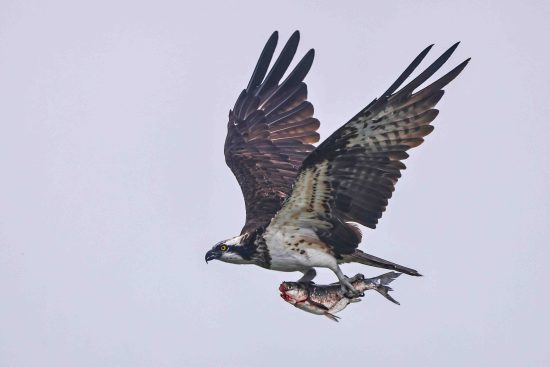
When it comes to raptors, few topics are as exciting as exploring osprey bird facts. The osprey (Pandion haliaetus), also known as the fish hawk, is a powerful bird of prey admired worldwide for its breathtaking dives, precise fishing skills, and remarkable adaptability. With piercing yellow eyes, a wingspan of nearly six feet, and talons specially designed to grip slippery fish, the osprey is perfectly equipped for an aquatic lifestyle that makes it one of the most fascinating raptors on Earth.
Found on almost every continent except Antarctica, the osprey is a global migratory raptor that connects ecosystems across the planet. From North America’s lakes to Asia’s rivers and Europe’s coastlines, this species thrives wherever clean water and abundant fish exist. Once severely impacted by pesticides, the osprey has made a powerful comeback, standing today as a living emblem of successful wildlife conservation.
In this blog, we’ll explore the most intriguing osprey bird facts—including its physical traits, hunting behavior, migration patterns, nesting and breeding habits, cultural significance, and conservation status. We’ll also share professional osprey photography tips so birdwatchers and photographers can capture the drama of this master fisherman in action—whether it’s soaring high in the sky or plunging with lightning speed into the water for its prey.
Whether you’re a dedicated birder, a passionate wildlife photographer, or simply curious about raptors, these osprey bird facts will deepen your appreciation for this extraordinary species and the fragile ecosystems it helps sustain.
🔍 Osprey Identification: What Does an Osprey Look Like?
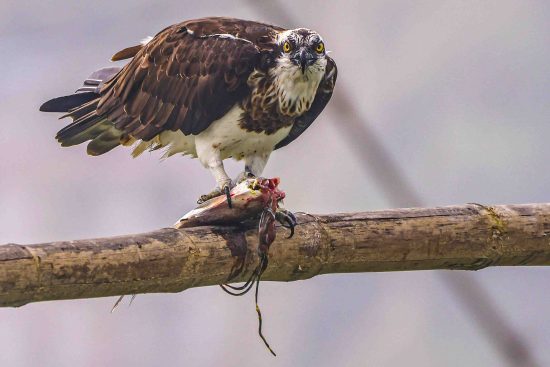
When learning Osprey Bird Facts, identification becomes easy once you focus on key features.
Size and Wingspan: Ospreys are large raptors. Their wingspan ranges between 1.5 and 1.8 meters (5–6 feet).
Plumage: They show a striking contrast. Dark brown covers the back and wings, while the chest and belly remain white. The head is mostly white, broken by a bold black eye stripe.
Beak and Talons: Their hooked beak tears flesh with ease. Spiny footpads and a reversible outer toe allow a powerful grip on slippery fish.
In Flight: Ospreys display long, angled wings that form a clear “M” shape when viewed from below. Their flight appears buoyant and graceful, unlike the heavier movement of eagles.
Vocalization: They often call with high-pitched whistles or short chirps. These sounds grow louder during breeding or when threatened.
Each feature serves a purpose. The contrasting plumage provides camouflage against sky and water. The strong talons and hooked beak make them expert hunters. The unique “M” wing shape helps birdwatchers identify them even at a distance.
If you’re exploring Osprey Bird Facts, remember this: the osprey’s body is a perfect design for fishing. Every trait, from its eyes to its talons, reflects its specialized hunting lifestyle.
🌍 Habitat and Distribution
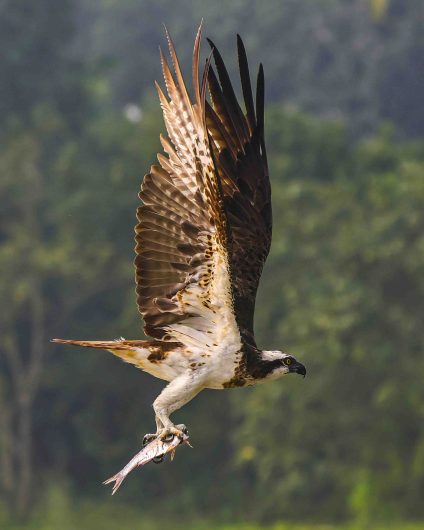
One of the most fascinating Osprey Bird Facts is their near-global presence. These powerful raptors live on every continent except Antarctica.
Preferred Habitats
Ospreys thrive wherever fish are plentiful. They soar above lakes, rivers, reservoirs, coastal lagoons, and estuaries, scanning for prey. Their sharp vision allows them to spot fish even from 40 meters above water.
Ospreys in India
In India, ospreys arrive as winter visitors. They frequent the Ganges, Brahmaputra, Chilika Lake, Sundarbans, and Keoladeo National Park. Birdwatchers often travel to these hotspots to witness their spectacular dives.
Nesting Sites
Another striking Osprey Bird Fact is their nesting adaptability. Ospreys build large stick nests on tree tops, cliffs, telephone poles, and even man-made nesting platforms designed for their safety. This flexibility helps them survive in both wild and urban landscapes.
Adaptability and Survival
Ospreys adapt quickly to environmental changes. Their ability to accept artificial nesting sites has protected them from habitat loss. This resilience explains their wide distribution and long-term survival.
🍽️ Diet and Hunting Behavior
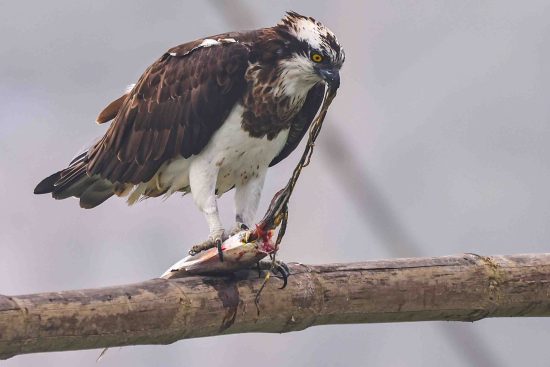
When it comes to Osprey Bird Facts, nothing is more striking than its diet. Unlike most raptors, the osprey is a true piscivore. Nearly 99% of its meals are live fish, making it one of nature’s most specialized hunters.
Hunting Technique
The osprey hovers gracefully above rivers, lakes, or coastlines.
It uses sharp vision to lock onto shimmering fish below.
Once prey is in range, it dives feet-first with outstretched talons.
Its reversible outer toe and spiny foot pads (spicules) ensure a powerful grip.
After catching a fish, it aligns the prey headfirst, reducing air resistance during flight.
Success Rate
Ospreys are not just skilled — they are efficient. Studies show a 60–70% success rate, one of the highest among all raptors. Few birds of prey match this level of precision and efficiency.
Diet Variety
Although fish dominate their diet, ospreys adapt to local waters. They feed on:
Trout and salmon in northern regions
Mullet and carp in rivers and estuaries
Catfish and tilapia in tropical waters
This adaptability helps ospreys thrive in diverse ecosystems across continents.
The “Fish Hawk”
Because of this specialization, the osprey is often called the fish hawk. Its entire lifestyle — from anatomy to hunting skills — revolves around fish. This makes it one of the most fascinating Osprey Bird Facts for bird lovers and photographers alike.
🐣 Breeding and Nesting
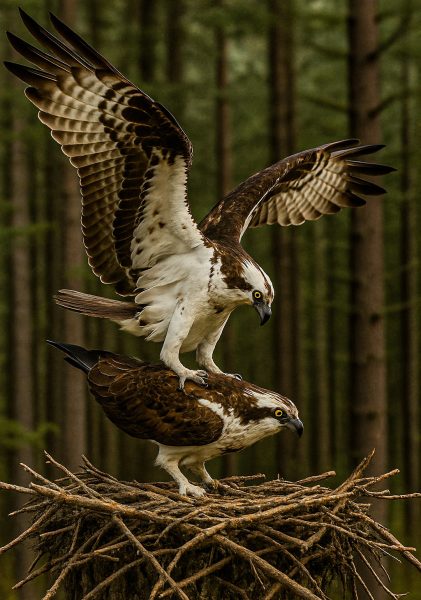
The breeding season is one of the most fascinating parts of Osprey Bird Facts. Ospreys display loyalty, skill, and strength during this period.
Nesting Sites: Ospreys build large stick nests on tall trees, cliffs, poles, and artificial platforms. They often return to the same nest every year. Each season, they add new material. Over time, nests can grow several meters wide and very heavy.
Pair Bonding: Ospreys form strong pair bonds. Courtship involves aerial displays, food offerings, and loud calls. These behaviors strengthen trust between mates.
Clutch Size: A female usually lays 2–4 eggs. Eggs have reddish-brown spots that help camouflage them.
Incubation: Incubation lasts 35–43 days. Both parents take turns, but the female does most of the brooding. The male focuses on hunting and delivering food.
Chick Development: Chicks hatch in sequence. The first chick is stronger and often dominates feeding. They fledge at 7–8 weeks, learning to fly and hunt soon after. Even after fledging, young ospreys rely on parents for food until they master fishing.
Nest Defense: Ospreys defend their nests fiercely. They chase away eagles, owls, and other predators that threaten eggs or chicks.
Conservation Efforts: Many conservation groups install artificial nesting platforms. Ospreys adapt to these structures quickly, which helps boost populations near rivers, lakes, and coastlines.
The breeding cycle of ospreys shows resilience and adaptability. These Osprey Bird Facts highlight how successful nesting ensures the survival of this remarkable raptor.
🧭 Migration Patterns
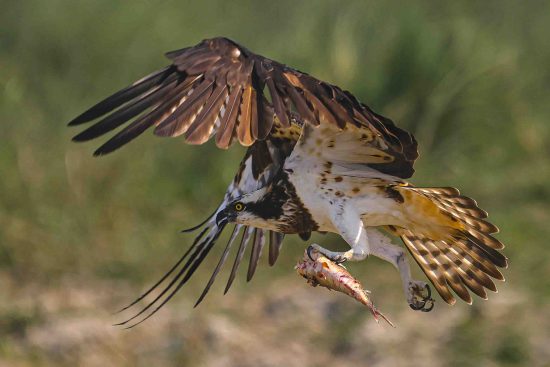
One of the most fascinating osprey bird facts is its incredible long-distance migration. These raptors connect continents and ecosystems through their seasonal journeys.
Seasonal Migration: Ospreys breed in North America, Europe, and Central Asia. As winter approaches, they travel to South America, Africa, India, and Southeast Asia. Some journeys exceed 5,000–6,000 kilometers.
Young Adventurers: Young ospreys often migrate alone. Guided by pure instinct, they navigate rivers, seas, and mountains without parental help. This instinct-driven voyage is one of the most amazing osprey bird facts.
India as a Winter Refuge: Between October and March, wetlands across India become prime osprey habitats. Birdwatchers often spot them near lakes, rivers, and coastal lagoons. India provides both food and shelter to these raptors.
Navigation Skills: Ospreys use a combination of the sun, magnetic fields, and visual landmarks to find their way. They return to the same wintering grounds year after year with stunning accuracy.
Global Connectors: Migration makes ospreys one of the few raptors linking northern breeding grounds with southern wintering ecosystems. They play a vital role in maintaining ecological balance across continents.
The migration journey of the osprey is not just a survival strategy. It is a living example of resilience, adaptability, and the power of instinct — a highlight among the most remarkable osprey bird facts.
🛡️ Conservation Status and Threats
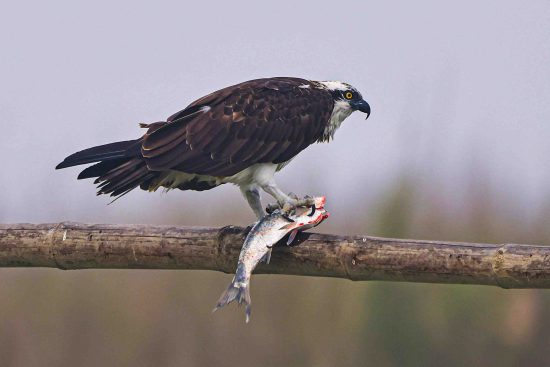
Yes. Since Conservation Status is one of the most important sections of your Osprey article, I would make it more substantial and clearly separate the global IUCN status from the Indian population trend. The latest State of India’s Birds information is particularly important here: although the Osprey is Least Concern globally, its Indian population shows a rapid long-term decline.
🌍 IUCN Red List Status
- 🟢 Species: Osprey
- 🔬 Scientific name: Pandion haliaetus
- 🛡️ Global IUCN category: Least Concern (LC)
- 📊 Global assessment: The species remains widespread across its large range.
- 🌎 Global perspective: The IUCN category assesses extinction risk at the global level.
The Least Concern category does not mean that the Osprey faces no threats. IUCN explains that some Least Concern species can still experience population declines. Continued monitoring remains important.
🇮🇳 Osprey Conservation Status in India
India presents a more concerning picture.
The State of India’s Birds 2025 assessment places the Osprey among species of High Priority in India. It reports a 57.1% long-term decline in the national trend dataset. The assessment also reports a current annual trend of -4.26%.
This difference matters.
A species can remain Least Concern globally while experiencing substantial declines in one country. Conservation decisions should therefore consider both global and regional evidence.
The Osprey is also listed under Schedule I of India’s Wild Life (Protection) Act in the State of India’s Birds assessment.
⚠️ Major Conservation Concerns
Several factors can affect Osprey populations and their breeding success.
- 💧 Loss of healthy wetlands: Ospreys depend heavily on water bodies with adequate fish populations.
- 🎣 Changes in fish availability: Their specialized diet makes them closely dependent on fish resources.
- 🏗️ Habitat modification: Shoreline development can remove suitable nesting and feeding areas.
- 🌳 Loss of nesting sites: Removal of large trees can reduce natural nesting opportunities.
- 🧪 Pollution: Contaminants can affect aquatic food webs and fish-eating birds.
- 🪢 Plastic and fishing-line entanglement: Discarded line and other materials can injure adults and chicks.
- 🌡️ Environmental change: Changes in weather and aquatic conditions can affect prey and breeding success.
Cornell Lab notes that discarded baling twine and plastic lines can become incorporated into Osprey nests. These materials can entangle chicks and cause serious injuries.
🧪 The DDT Crisis and Osprey Recovery
The Osprey has an important conservation history.
During the mid-20th century, widespread use of DDT caused severe declines in many fish-eating birds. Ospreys suffered major population losses in several regions. Their eggshells became thinner, reducing successful reproduction.
Along parts of the northeastern United States, breeding pairs declined dramatically during the DDT era.
The United States banned DDT in 1972. Osprey populations then recovered in many areas. Researchers also developed artificial nesting platforms to support breeding populations.
This recovery shows how conservation action can change the future of a species.
It also demonstrates why long-term monitoring matters. Population trends can reveal problems before they become irreversible.
📊 What the Indian Report Tells Us
The State of India’s Birds provides an important regional warning.
Its 2025 Osprey assessment reports:
- 📉 Long-term trend: Rapid Decline
- 📉 Long-term change: -57.1%
- 📉 Current annual trend: -4.26%
- 🗺️ Distribution range: Approximately 889,976 km²
- 🛡️ Global IUCN status: Least Concern
- 🇮🇳 Indian legal status: Schedule I under the Wild Life (Protection) Act
The report therefore shows a clear contrast between the species’ global and Indian assessments.
The earlier State of India’s Birds 2023 assessment also recorded a rapid decline. It estimated a 61.76% long-term decline and a 5.49% current annual decline. The newer 2025 update reports different values. This reflects updated analysis and should not be treated as a contradiction.
🌿 How Conservation Can Help
Protecting Ospreys requires protecting their entire ecological system.
- 💧 Protect wetlands, rivers, lakes, reservoirs, and coastal waters.
- 🐟 Maintain healthy fish populations.
- 🌳 Preserve suitable nesting trees and structures.
- 🪺 Install safe artificial nesting platforms where appropriate.
- 🧹 Remove hazardous fishing line and plastic from nesting areas.
- 🧪 Reduce pollution entering aquatic ecosystems.
- 📊 Continue long-term population monitoring.
- 🛑 Minimize disturbance around active nests.
Artificial nesting platforms have already supported Osprey recovery in several regions. Cornell’s research also highlights their increasing importance where natural nesting sites disappear.
📷 The Role of Wildlife Photographers
Wildlife photographers can contribute to Osprey conservation without disturbing the birds.
- 📸 Photograph from a safe distance.
- 🪺 Avoid approaching active nests.
- 🚫 Never bait an Osprey for a photograph.
- 🎣 Do not manipulate fish or feeding opportunities.
- 🔇 Avoid repeated playback of calls.
- 🗺️ Avoid publishing sensitive nest locations.
- 🌿 Show the bird within its natural habitat when possible.
- 📚 Share accurate conservation information with photographs.
A powerful Osprey photograph can do more than display a beautiful bird. It can show the relationship between the bird, fish, wetlands, and people.
💚 Why the Osprey Still Needs Attention
The Osprey’s Least Concern global status should not create complacency.
Its worldwide population remains sufficiently widespread to avoid a threatened IUCN category. Yet regional declines can reveal serious conservation problems. India demonstrates this difference clearly.
Protecting Ospreys means protecting the waters they depend on.
Healthy fish populations support feeding. Safe nesting sites support breeding. Clean waterways support the entire aquatic food web.
For wildlife photographers, this creates an important responsibility.
The goal should not only be to photograph the Osprey. The goal should also be to protect the places that allow it to return.
🛡️ Conservation Message
The Osprey is a powerful example of conservation success and continuing conservation responsibility.
Its global Least Concern status reflects its broad distribution and overall extinction risk. Its declining Indian trend reminds us that local populations can face very different pressures.
Protecting wetlands, fish populations, nesting sites, and clean waterways remains essential.
Every protected wetland gives the Osprey another place to hunt, breed, and survive.
📚 Interesting Facts about Osprey
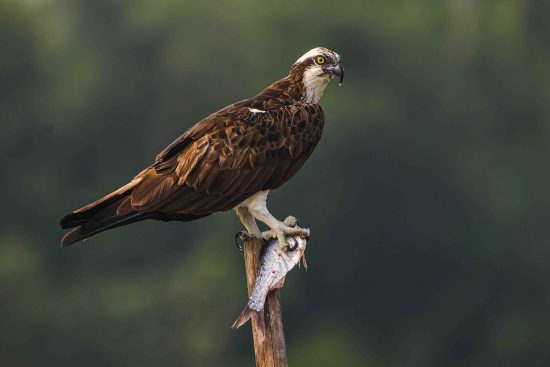
Looking for the most fascinating Osprey Bird Facts? These raptors never fail to amaze birdwatchers and nature lovers.
Unique Genus: Ospreys are the only raptor species in their own genus, Pandion. That makes them truly special.
Underwater Adaptation: They close their nostrils when diving, allowing clean, swift plunges into water.
Waterproof Feathers: Ospreys have oily, waterproof plumage that keeps them dry and buoyant after fishing dives.
Powerful Hunters: An osprey can carry fish weighing up to half its body weight with ease.
Amazing Migration: Ospreys travel incredible distances, sometimes flying over 160,000 km during their lifetime.
Special Vision: Their sharp eyesight spots fish from over 30 meters above water.
Reversible Toes: Ospreys have zygodactyl feet, two toes forward and two backward, perfect for gripping slippery fish.
Global Presence: You can find Ospreys on every continent except Antarctica.
Conservation Symbol: Their recovery after DDT bans makes them a success story in wildlife conservation.
Lifelong Bonds: Many Osprey pairs mate for life, returning to the same nest year after year.
👉 These Osprey Bird Facts highlight their hunting skills, survival adaptations, and cultural importance. Every birder should know them!
📸 Photography and Birdwatching Tips
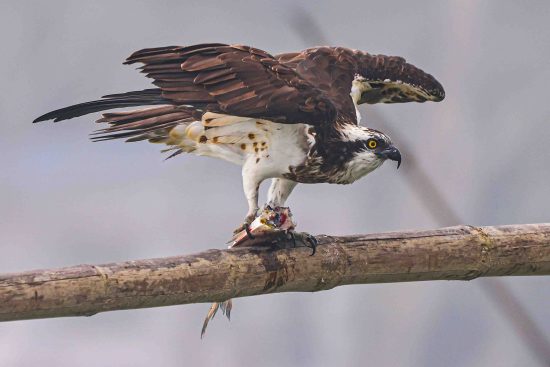
Photographing an Osprey demands patience, timing, and fast camera control. Its fishing dives create some of the most dramatic moments in wildlife photography. The bird may hover, dive, hit the water, and rise with a fish within seconds.
Use these techniques to capture those moments with greater control.
🌅 Choose the Right Location
- 💧 Look for lakes, rivers, reservoirs, and coastal waters.
- 🐟 Choose areas with regular fish activity.
- 🪵 Watch for favourite perches and hunting zones.
- 🧭 Study the Osprey’s usual flight path.
- 🌬️ Check the wind before you start shooting.
Ospreys often hunt around open water. Their fishing routes can become predictable. Use that pattern to plan your position.
☀️ Work With the Light
- 🌞 Keep the sun behind you when possible.
- ✨ Use soft morning or evening light.
- 🪶 Watch for clean light on the white head and underparts.
- 🌅 Avoid harsh midday light when you can.
- 🔄 Move when the background becomes distracting.
Front light can reveal feather detail. Side light can add depth and drama.
⚙️ Use Fast Camera Settings
Osprey flight can change quickly. Start with a fast shutter speed.
- ⚡ Shutter: 1/2500 sec or faster
- 🎯 Aperture: f/5.6–f/8
- 📈 ISO: Raise it as light falls
- 🔄 Drive: Continuous high-speed burst
- 🎯 Focus: Continuous AF / tracking
- 📐 AF area: Use expanded or group points when suitable
Cornell Lab recommends very fast shutter speeds for flight. It gives 1/2500 sec to 1/3200 sec or higher as useful starting points.
🦅 Track the Osprey
Keep your eyes on the bird.
Do not stare only at the camera screen.
- 👁️ Find the Osprey early.
- 🎯 Place the focus point on the head or body.
- 🪽 Follow its flight smoothly.
- 🔄 Keep moving with the bird.
- 📸 Start bursts before peak action.
Practice tracking before the Osprey reaches the ideal position. Cornell photographers also recommend maintaining focus while following the bird.
🌊 Capture the Fishing Dive
This is the signature Osprey photograph.
Watch the bird closely.
First, it may hover above the water. Then it turns sharply. Its wings pull back. Its talons stretch forward. The bird drops toward the surface.
That is your moment.
- 🎯 Track the bird before the dive.
- ⚡ Keep a fast shutter speed.
- 📸 Use continuous bursts.
- 🦶 Watch for the talons.
- 💦 Capture the water splash.
- 🐟 Look for the moment it emerges with a fish.
The dive happens fast. Anticipation matters more than reaction.
🐟 Photograph the Catch
Do not stop after the dive.
The Osprey may emerge with a fish. Keep tracking it.
Look for:
- 🐟 Fish locked in the talons
- 💦 Water droplets falling away
- 🪽 Fully spread wings
- 👁️ Sharp eye contact
- 🌊 Reflections or ripples
- 🏞️ A clean natural background
These details can turn an action shot into a powerful wildlife story.
🎨 Improve Your Composition
Avoid placing the Osprey in the center every time.
Try different compositions.
- 📐 Leave space ahead of the bird.
- 🪽 Give the wings room to breathe.
- 🎯 Place the eye near a third.
- 🌊 Include water when it adds context.
- 🌿 Use natural perches as foreground elements.
- 🖼️ Try both horizontal and vertical frames.
A little empty space can make the flight feel faster.
🪶 Photograph More Than Action
Do not chase only the dive.
Capture the Osprey:
- 🌳 Resting on a perch
- 🪺 Near its nest
- 🪽 Gliding over water
- 🐟 Carrying prey
- 💦 Shaking water from its feathers
- 👁️ Scanning the surface
- 🌅 Flying through warm evening light
A varied photo series tells a stronger story than one action frame.
🚫 Follow Ethical Wildlife Practices
Great wildlife photography should never disturb the bird.
- 🔇 Keep your distance.
- 🚫 Never bait an Osprey.
- 🐟 Never place fish for a photograph.
- 🪺 Never approach an active nest.
- 🔊 Avoid repeated playback.
- 🚶 Move slowly and quietly.
- 🌿 Respect protected areas and local rules.
Your photograph should record natural behavior. It should never create that behavior.
📷 Final Field Tip
Watch first. Shoot second.
Learn where the Osprey hunts. Study its flight. Notice the wind. Read its body language.
Then prepare your settings.
When the bird dives, trust your tracking and keep shooting.
The perfect frame may last less than a second. Patience puts you there. Preparation helps you capture it.
📘 Why Documentation Matters & How You Can Help
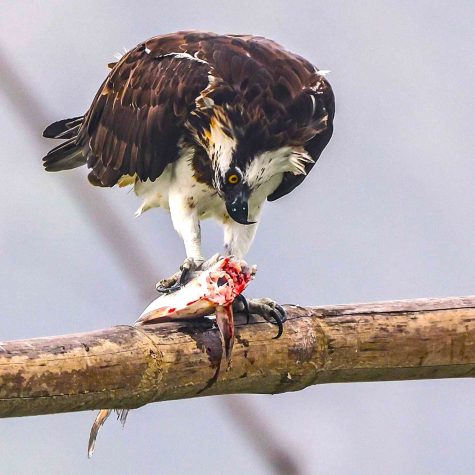
Among the most important osprey bird facts is that documentation directly supports conservation. Ospreys are long-distance migrants, crossing continents and ecosystems. Tracking their movements helps scientists understand climate impacts, identify critical wetlands, and measure population trends. Without consistent records, it would be nearly impossible to protect their habitats effectively.
Why Documentation Matters
Migration Insights: Photos, field notes, and GPS-tagged reports reveal precise migration routes. This information highlights stopover sites that need urgent protection.
Breeding Success: Documenting nest activity helps conservationists measure chick survival rates and breeding productivity.
Habitat Health: The presence or absence of ospreys often signals the health of wetlands, rivers, and fish populations. Documented sightings give policymakers real-time ecological data.
Public Awareness: Every shared osprey photo on social media sparks curiosity and spreads knowledge, turning a single image into a tool for conservation.
How You Can Help
Your role as a birdwatcher, photographer, or nature lover is more powerful than you think. Here’s how to contribute:
Report Sightings: Upload your osprey observations to citizen science platforms like eBird, iNaturalist, or local bird monitoring programs.
Practice Responsible Photography: Keep a safe distance from nests, avoid using drones near breeding sites, and never disturb hunting ospreys. Respect ensures their natural behavior continues undisturbed.
Support Conservation Projects: Donate to or volunteer with organizations that protect wetlands and raptors. Many groups fund artificial nesting platforms, research projects, and habitat restoration.
Educate and Inspire: Share your images, write blogs, or post osprey stories online. By highlighting fascinating osprey bird facts, you turn awareness into action.
Adopt Sustainable Practices: Reduce plastic use, support clean water initiatives, and promote fish-friendly policies. Protecting wetlands ultimately safeguards osprey survival.
A Shared Responsibility
The osprey connects ecosystems across the globe. Protecting it means protecting rivers in Asia, coastlines in Africa, and forests in the Americas. Documentation ensures these connections remain visible. Action ensures they remain strong. Together, they create a powerful conservation story where science, photography, and community efforts combine to secure the osprey’s future.
By documenting responsibly and acting consciously, you become more than an observer — you become a guardian of the osprey’s legacy.
🎎 Cultural Significance of the Osprey
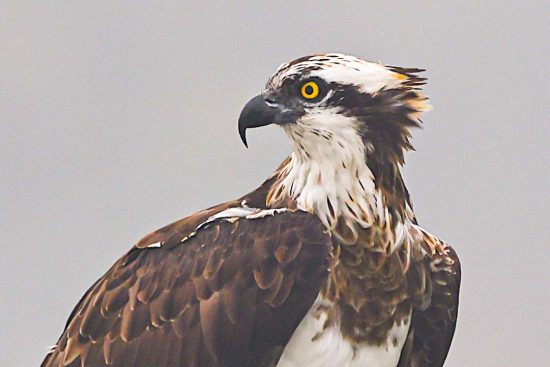
The Osprey is not only a master fisherman but also a bird deeply woven into human culture, symbolism, and folklore. Across continents, people have admired its strength, persistence, and hunting skills. These qualities made the osprey a symbol of vision, survival, and harmony with water.
Symbol of Power and Vision: Ancient cultures associated the osprey with sharp sight and determination. Its ability to dive with precision inspired respect among coastal communities.
Role in Folklore: In Roman mythology, ospreys represented courage and fairness. In some Native American traditions, they stood for honesty, patience, and the balance of nature.
Cultural Representation: Sailors once considered the osprey a guardian bird, a positive omen for safe travels and rich fishing grounds. In Asia and Europe, ospreys appear in art, poetry, and stories, often linked with rivers and seas.
Modern Symbolism: Today, conservation groups use the osprey as a global icon of wildlife recovery and resilience. After their populations declined due to pesticides, their successful comeback is celebrated worldwide.
Eco-tourism and Education: Ospreys attract birdwatchers and photographers, creating awareness about wetlands, rivers, and coastal ecosystems. They remind us that healthy fish populations and clean waters sustain both people and wildlife.
The cultural story of the osprey connects human survival with nature’s balance. These insights enrich our understanding of Osprey Bird Facts beyond biology, showing how this raptor bridges ecology and tradition.
❓ Frequently Asked Questions (FAQ)
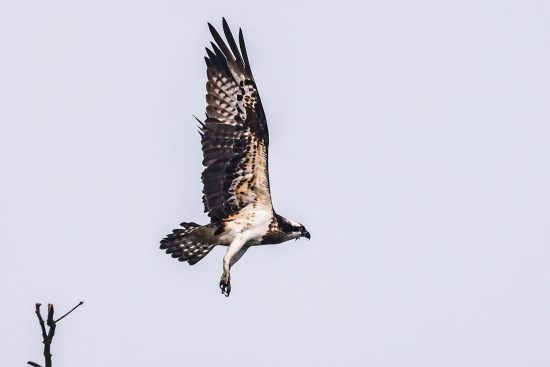
Q1. What makes the osprey unique among raptors?
The osprey is the only raptor in its own genus, Pandion. Unlike most raptors, it feeds almost entirely on fish. This specialization makes it one of the most distinctive Osprey Bird Facts.
Q2. Where can you find ospreys?
Ospreys live on every continent except Antarctica. They thrive near rivers, lakes, reservoirs, and coastal waters, wherever fish are abundant.
Q3. How do ospreys catch fish so efficiently?
Ospreys dive feet-first into water, using sharp talons and reversible toes to grip slippery fish. Their waterproof feathers keep them buoyant after dives.
Q4. Do ospreys migrate long distances?
Yes. Ospreys are long-distance migrants. Some individuals travel thousands of kilometers between breeding and wintering grounds, covering up to 160,000 km in their lifetime.
Q5. What role do ospreys play in culture and symbolism?
Across cultures, ospreys symbolize vision, strength, and resilience. In Roman myths, they represented fairness, while sailors viewed them as omens of safe travel.
Q6. Are ospreys endangered?
No. The osprey currently holds an IUCN status of Least Concern. However, they once faced severe declines due to pesticide use. Their recovery is now a global conservation success story.
Q7. What is the lifespan of an osprey in the wild?
Ospreys can live up to 20–25 years in the wild, though many do not survive their first migration.
Q8. Do ospreys mate for life?
Yes. Many osprey pairs form lifelong bonds, often returning to the same nesting site year after year.
✨ Conclusion: The Global Guardian of Wetlands
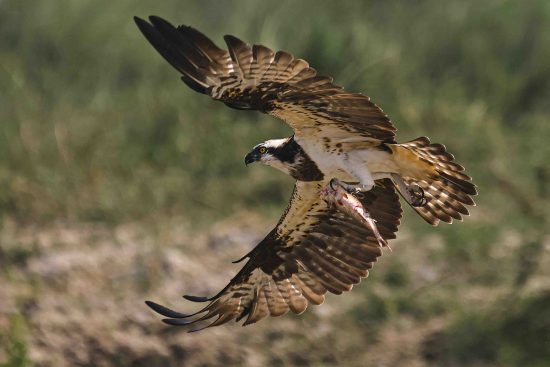
The osprey is more than just a bird of prey—it is a global icon of resilience, precision, and survival. From its specialized talons and reversible toes to its breathtaking dives and epic migrations, every detail of its life showcases nature’s brilliance. Once pushed to the brink by human activity, the osprey has rebounded, becoming a powerful symbol of successful conservation.
For birdwatchers, photographers, and nature lovers, seeing an osprey hover above the water before plunging down to seize a fish is unforgettable. These moments highlight why protecting wetlands and rivers is vital—not just for ospreys but for countless species that share their habitat.
✨ Call to Action: If you’ve enjoyed exploring these Osprey Bird Facts, don’t stop here. Share this article with fellow bird lovers, educators, and photographers to spread awareness about this master fisherman of the skies. Support wetland conservation programs to ensure that future generations can witness the osprey’s spectacular dives and hear its wild calls across lakes and coasts.
👉 Next time you are near a river or lake, keep your binoculars ready. You may just spot the osprey in action—proof that with awareness and care, nature’s wonders can thrive alongside us.
Recent Comments