

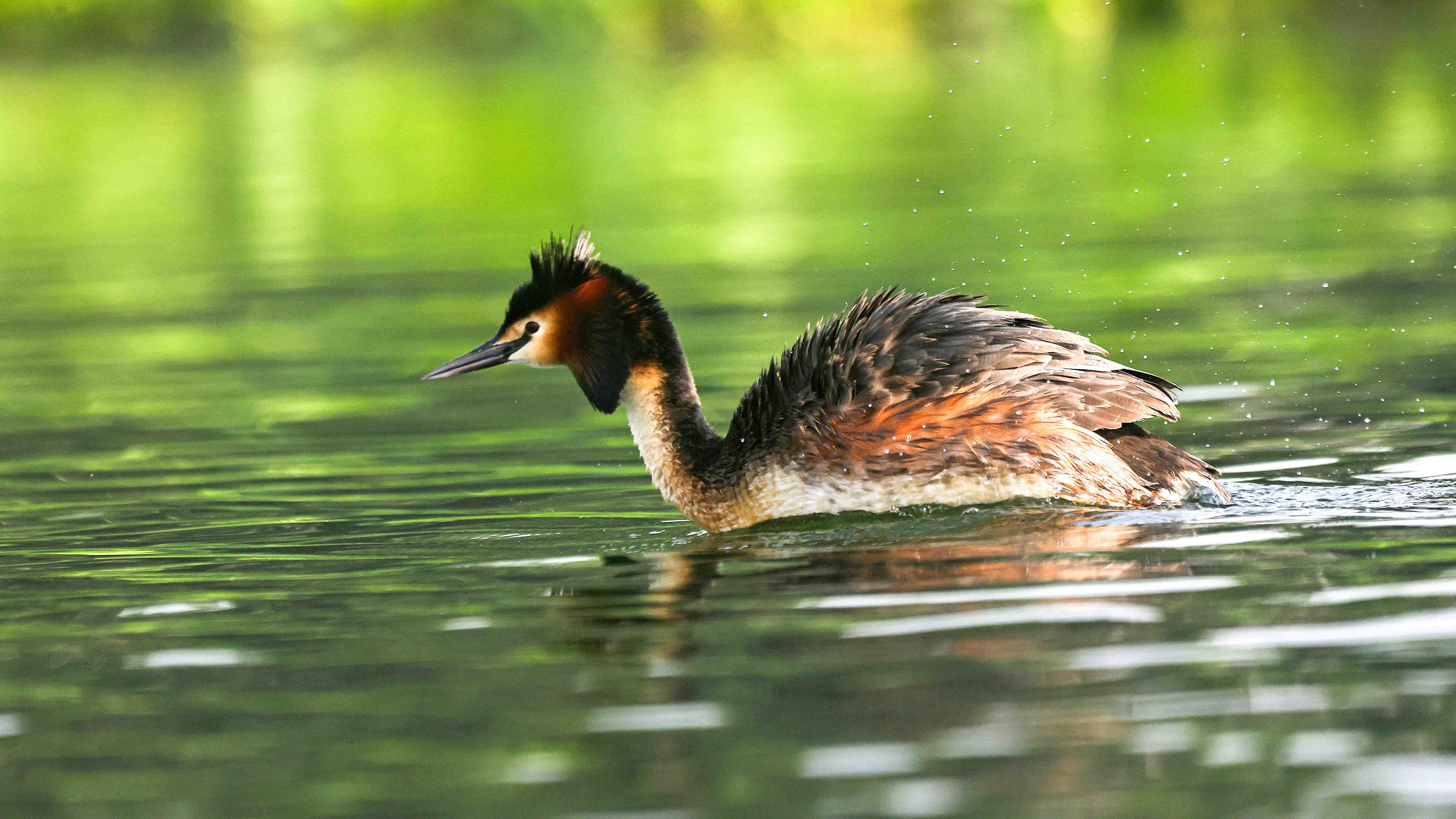
Great Crested Grebe: A Stunning Waterbird of Wetlands
📖 Index: Great Crested Grebe
🦆 Quick Navigation
- 🦆 Introduction: Great Crested Grebe
- 🖼️ Physical Appearance
- 🌍 Habitat & Distribution
- 🍽️ Food Habits
- 💃 Courtship Ritual: A Water Ballet
- 🐣 Nesting Behavior
- 🎎 Cultural & Local Significance
- 📸 Photography Tips
- 📘 Why Documenting Them Matters
- 🛡️ Conservation Status
- ✨ Fun Facts
- ❓ Frequently Asked Questions (FAQs)
- 📘 Conclusion: Protecting Wetland Poetry
🦆 Introduction: Great Crested Grebe
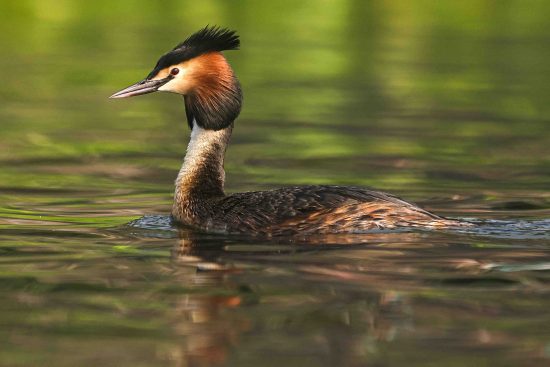
The Great Crested Grebe (Podiceps cristatus) is one of the most graceful and captivating freshwater birds in the world. Known for its striking plumage, elaborate courtship rituals, and elegant swimming style, it has fascinated naturalists, birdwatchers, and photographers for centuries. Once nearly driven to extinction in parts of Europe due to hunting for its ornate feathers, this species has staged an inspiring comeback through dedicated conservation.
From the shimmering lakes of Europe to the quiet wetlands of Asia, Africa, and Australia, the Great Crested Grebe is often seen gliding silently across calm waters before suddenly diving deep in pursuit of fish. Its iconic “weed dance” courtship ritual has made it one of the most celebrated waterbirds, symbolizing both beauty and resilience in wetland ecosystem.
🖼️ Physical Appearance
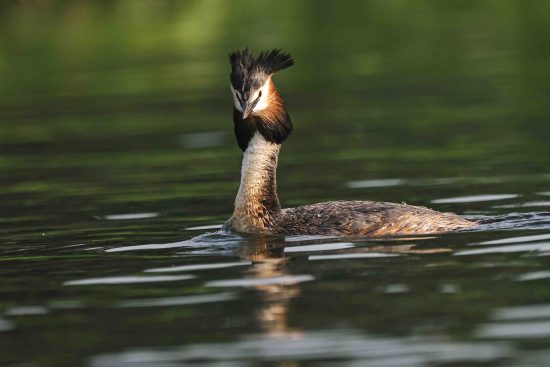
The Great Crested Grebe is a medium-to-large waterbird with elegant proportions and striking features:
Size: 46–51 cm in length, with a wingspan of 59–73 cm.
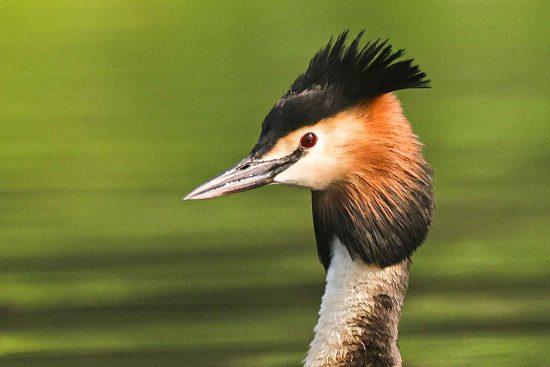
Plumage: Dark brown back, white underparts, and during breeding season, adorned with ornate black double crests and chestnut frills on the head.
Eyes: Distinctive red irises that stand out dramatically against its plumage.
Bill: Long, sharp, and pointed — adapted for spearing fish.
Behavioral Traits:
Excellent divers, capable of staying underwater for up to 30 seconds.
Strong fliers, though they prefer to escape danger by diving rather than taking flight.
Territorial during the breeding season, with pairs defending nesting sites vigorously.
✅ Key Identification Features:
- Breeding Plumage: Striking head frills and crests, making identification unmistakable.
- Non-breeding Plumage: Plainer appearance, with a whitish face and neck.
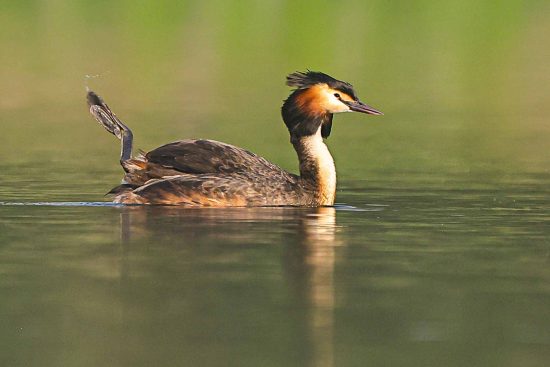
- Swimming Posture: Characteristic low-floating body, with head and neck raised elegantly above the waterline.
- Chicks: Striped, often seen riding on their parents’ backs — one of the most endearing behaviors in the bird world.
🌍 Habitat & Distribution
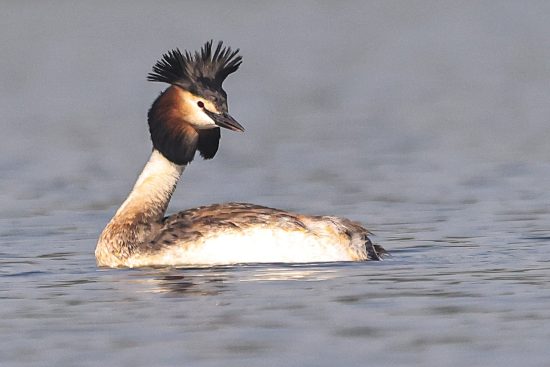
The Great Crested Grebe thrives in freshwater lakes, ponds, marshes, and slow-moving rivers with dense aquatic vegetation. These wetlands provide cover, nesting material, and hunting grounds.
Breeding Range: The Great Crested Grebe breeds across Europe, Asia, and parts of Africa, favoring reed-rich wetlands.
Wintering Range: Many populations migrate to coastal estuaries, sheltered bays, and large inland reservoirs after breeding.
In India: Winter visitors appear in northern wetlands, reservoirs, and expansive water bodies.
This species adapts well to both inland and coastal habitats. Such flexibility helps maintain stable populations despite growing environmental pressures. However, pollution, wetland destruction, and human disturbance cause local declines.
The Great Crested Grebe’s wide distribution makes it a familiar yet vital bird. Protecting its wetlands safeguards biodiversity and ensures future sightings of this elegant diver.
🍽️ Food Habits
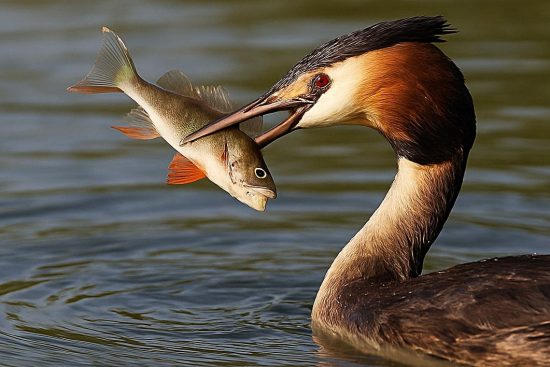
1. Fish (main diet)
Small to medium-sized freshwater fish (e.g., perch, roach, minnows)
Swallowed whole, head first
Skilled underwater hunters that use their sharp, pointed beaks and agile diving skills
2. Aquatic Invertebrates
Insects and insect larvae (dragonflies, caddisflies, water beetles)
Crustaceans and small mollusks (snails, freshwater shrimp)
3. Amphibians (Occasionally)
Tadpoles or small frogs during breeding season if fish are scarce
4. Feathers (Surprisingly!)
- Grebes often eat their own feathers or feed them to their chicks
- Helps in digestive protection by forming a filter to trap bones and other hard parts
Their hunting method involves agile underwater pursuit dives, using their powerful legs and streamlined body to chase prey with remarkable accuracy.
💃 Courtship Ritual: A Water Ballet
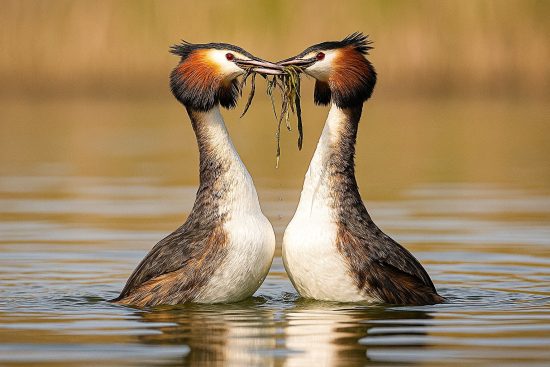
Few birds rival the Great Crested Grebe in courtship displays. Their rituals rank among the most spectacular behaviors in ornithology.
The Weed Dance: Both partners rise chest-to-chest, holding aquatic plants while shaking heads in dramatic unison.
Synchronized Swimming: Graceful, mirrored movements across the water highlight perfect coordination between mates.
Head-Shaking Displays: Rapid head shakes reinforce pair bonds and signal readiness for breeding.
These rituals strengthen pair commitment and ensure successful nesting. Birdwatchers and photographers flock to wetlands each spring to witness this breathtaking spectacle.
The Great Crested Grebe courtship dance also signals ecosystem health, as it thrives only in clean, vegetation-rich waters.
🐣 Nesting & Breeding Behavior
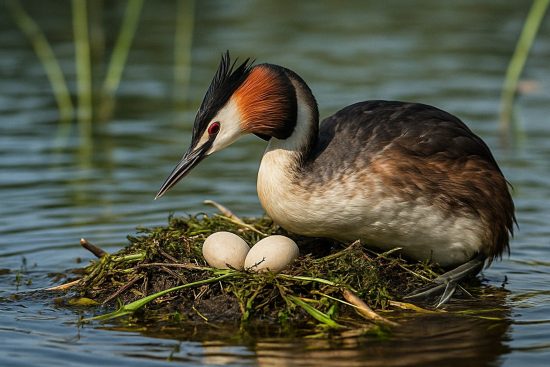
The Great Crested Grebe begins breeding between March and July, though timing varies with region and climate.
Nest Type: Floating platforms built from reeds and aquatic vegetation, anchored securely to emergent plants.
Clutch Size: Usually 3–5 eggs, laid and guarded carefully.
Parental Roles: Both parents share incubation and feeding duties equally.
Chick Behavior: Striped chicks ride on their parents’ backs for warmth, safety, and protection from predators.
This back-riding habit creates one of the most iconic sights in bird photography. It also reflects strong parental care.
The Great Crested Grebe depends on healthy wetlands for breeding success. Loss of reeds and pollution threaten nesting opportunities across many regions.
By observing and documenting their breeding behavior, photographers and birders highlight the urgent need for wetland conservation.
🎎 Cultural & Local Significance
The Great Crested Grebe holds deep cultural meaning across regions and centuries. In Victorian England, it became a symbol of early wildlife conservation. Campaigns saved the bird from near extinction, inspiring future protection movements.
Today, the Great Crested Grebe represents wetland health and ecological resilience. Its presence signals clean water, thriving vegetation, and balanced ecosystems. Birders often use it as an indicator of wetland quality.
In many cultures, the bird’s courtship dance symbolizes romance, fidelity, and harmony with nature. These rituals inspire artists, poets, and photographers worldwide. Communities near wetlands celebrate the grebe as a messenger of renewal and seasonal change.
Local folklore often portrays the Great Crested Grebe as a guardian of water bodies. Some traditions link its elegant appearance to purity and persistence. Its strong bond with wetlands reminds people of the need to protect fragile aquatic landscapes.
The Great Crested Grebe’s cultural value continues to grow through eco-tourism, bird festivals, and conservation programs. Showcasing this bird highlights the shared relationship between people and wetlands.
📸 Photography Tips for Capturing the Great Crested Grebe
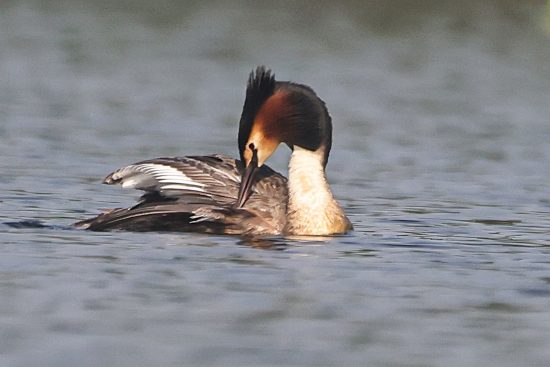
Photographing the Great Crested Grebe (Podiceps cristatus) is an unforgettable experience for any wildlife photographer. From its graceful swimming posture to the world-famous weed dance courtship ritual, the bird offers endless opportunities for breathtaking photography. Here’s how you can master the art of capturing this stunning waterbird:
🌅 Choose the Right Light
Soft light works beautifully with this waterbird.
- 🌄 Shoot during the golden hours.
- ☁️ Use overcast light for soft plumage detail.
- ✨ Watch for reflections on calm water.
- 🔆 Avoid harsh midday light when possible.
Early light can create warm tones and gentle reflections. It also adds depth to the bird’s dark and pale plumage.
📍 Get Low to the Water
A low viewpoint can transform your images.
Position yourself close to water level when the location allows it. This angle creates a smoother background and stronger reflections.
It also makes the grebe appear more immersed in its aquatic world.
Keep your distance. Never approach a bird just for a lower angle.
🎯 Focus on the Eye
The eye should remain the visual anchor.
- 👁️ Use single-point or animal-eye AF.
- 🎯 Place the focus point over the eye.
- ⚡ Use continuous autofocus for moving birds.
- 📷 Shoot short bursts during active behavior.
A sharp eye can make even a simple portrait feel powerful.
🌊 Capture the Dive
Great Crested Grebes often dive to feed and escape danger. They can disappear quickly beneath the surface.
Watch the bird closely before it dives.
Look for changes in posture. A slight body movement can signal the next dive.
Use a fast shutter speed when you expect sudden movement.
💕 Photograph the Courtship Dance
The courtship display offers one of the best photographic moments.
Pairs may shake their heads together. They can then dive and return with waterweed. Both birds may rise chest-to-chest while displaying the vegetation.
- 💕 Frame both birds together.
- ⚡ Use a fast shutter speed.
- 🎯 Track both heads.
- 📸 Shoot continuous bursts.
- 🌊 Leave space around the birds.
Try to capture the moment when both birds rise together. This creates a strong sense of symmetry and movement.
🪶 Photograph Breeding Plumage
Breeding birds show their dramatic head crests. Their warm tones can stand out beautifully against blue or green water.
Expose carefully for bright feathers. Check your highlights often.
A clean background will make the crest more striking.
🐣 Include Family Moments
Young grebes can ride on their parents’ backs.
These scenes create intimate storytelling images.
Use a longer lens when needed. Keep enough space around the family.
Avoid chasing adults or chicks for a closer frame.
⚙️ Useful Camera Settings
For active grebes, try:
- ⚡ Shutter: 1/1000s or faster
- 🎯 AF: Continuous AF
- 📷 Drive: High-speed burst
- 🔭 Lens: 400–600mm
- 🌤️ ISO: Adjust to maintain shutter speed
- 📐 Aperture: Around f/5.6–f/8 when light allows
Adjust these settings as conditions change.
🌿 Practice Ethical Photography
Respect the bird before the photograph.
Never chase a grebe into the water. Avoid disturbing courtship, nesting, or feeding behavior.
The best photograph captures natural behavior without changing it.
📘 Why Documenting Them Matters
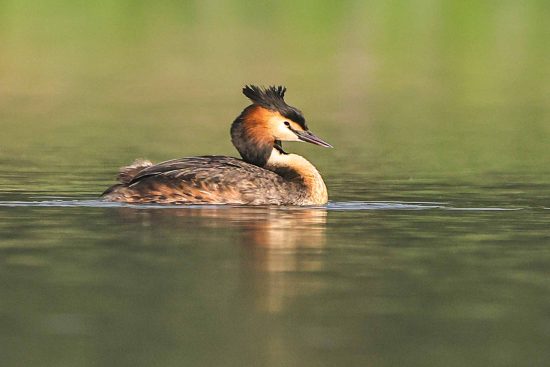
Documenting the Great Crested Grebe through photography, videography, and citizen science is more than just a creative pursuit — it is a powerful tool for conservation, education, and awareness.
Raising Awareness – Stunning images of the Great Crested Grebe’s weed dance, chick-back rides, and elegant swimming inspire admiration and empathy, motivating people to care about wetland protection.
Supporting Conservation – Photographic evidence helps highlight habitat loss, pollution, and human disturbance. Such documentation strengthens the case for wetland conservation projects and policy advocacy.
Scientific Contribution – Observations recorded by photographers and birders provide valuable data for researchers tracking grebe population trends, migration patterns, and breeding success.
Promoting Eco-tourism – Captivating images of the Great Crested Grebe attract birdwatchers and nature lovers to lakes and wetlands, supporting local communities and encouraging sustainable tourism.
Inspiring Action – Documenting these birds connects people to the fragility of wetlands and the urgent need to preserve freshwater ecosystems that benefit both wildlife and humans.
✨ In short: Every photograph or field note of the Great Crested Grebe becomes part of a larger story — one that can protect wetlands, educate the public, and preserve this elegant species for generations to come.
🛡️ Conservation Status
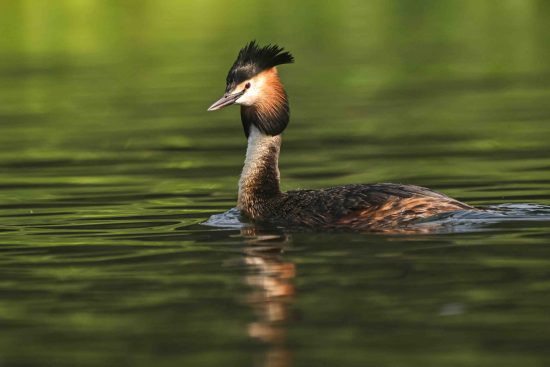
The Great Crested Grebe (Podiceps cristatus) has a Least Concern (LC) status on the IUCN Red List.
However, its Indian population shows a more concerning trend. The State of India’s Birds 2025 assessment places the species under High Conservation Priority in India.
🌍 IUCN Red List Status
- 🦆 Species: Great Crested Grebe
- 🔬 Scientific name: Podiceps cristatus
- 🟢 Global IUCN status: Least Concern (LC)
- 🌎 Global assessment: Least Concern
- 💧 Ecological group: Wetland bird
The Least Concern category applies at the global level.
It does not mean every population remains stable.
Regional declines can still demand close attention and monitoring.
🇮🇳 Conservation Status in India
India presents a much more serious picture.
The State of India’s Birds 2025 assessment places the Great Crested Grebe in the High Priority category.
Its national trend shows a clear decline.
- 📉 Long-term trend: Rapid Decline
- 📉 Long-term change: -58.29%
- 📊 Current annual trend: -2.54%
- 🗺️ Distribution range: 286,859 km²
- 🛡️ Wild Life Protection Act: Schedule II
- 🦆 Status in India: Resident and winter migrant
- 💧 Habitat specialization: Wetland
These figures come from the State of India’s Birds 2025 update.
🚨 Why the Indian Trend Matters
The Great Crested Grebe shows an important conservation lesson.
A species can remain Least Concern globally while declining rapidly in India.
The Indian data therefore deserve serious attention.
The 2025 report used 48 million eBird observations collected through May 2025.
This large dataset strengthens our understanding of population trends.
💧 Wetland Dependence
The Great Crested Grebe depends strongly on wetland environments.
Changes in these habitats can affect its breeding and feeding opportunities.
Key pressures can include:
- 🏗️ Wetland modification
- 🚧 Urban development near lakes
- 🎣 Fishing-net entanglement
- 🛢️ Water pollution and oil contamination
- 🐟 Changes in aquatic food resources
- 🌊 Altered water conditions
- 🐦 Disturbance around breeding sites
Historical studies also identify lake modification, introduced species, fishing nets, and pollution among potential threats.
📊 A Changing Conservation Picture
The earlier State of India’s Birds 2023 assessment reported an even steeper long-term decline of 72.21%.
It also recorded a current annual decline of 3.89%.
The newer 2025 update gives different values.
This change reflects updated data and analysis.
The latest figures should therefore guide the current discussion.
🌿 What Protection Requires
The Great Crested Grebe needs healthy wetlands to thrive.
Conservation should focus on:
- 💧 Protecting natural lakes and wetlands
- 🌱 Maintaining aquatic vegetation
- 🚫 Reducing disturbance near breeding areas
- 🕸️ Preventing harmful fishing-net interactions
- 🧪 Limiting water pollution
- 📊 Continuing long-term population surveys
- 🛡️ Protecting important wintering sites
📷 A Message for Wildlife Photographers
Photographers can help document the species responsibly.
A detailed photograph can reveal plumage, breeding behaviour, and habitat use.
But photographers should keep their distance.
They should never disturb nesting birds for a better frame.
Responsible photography can also raise awareness about declining wetland birds.
💚 Conservation Message
The Great Crested Grebe remains Least Concern globally.
Yet India tells a different story.
Its 58.29% long-term decline deserves attention.
The species needs healthy wetlands, safe breeding areas, and continued monitoring.
Protect the wetlands, and we protect the grebe’s future.
✨ Fun Facts
Courtship Dance Stars – The Great Crested Grebe is famous for its “weed dance”, where a pair rises out of the water chest-to-chest while presenting aquatic plants.
Feather Eaters – Unlike most birds, grebes swallow their own feathers — and even feed them to their chicks — to help trap fish bones in the stomach for digestion.
Comeback Story – In the 1800s, Great Crested Grebes were hunted nearly to extinction in the UK for their ornate head plumes, used to decorate hats. Conservation saved them.
Master Divers – They can dive underwater for up to 30 seconds and chase fish with incredible agility.
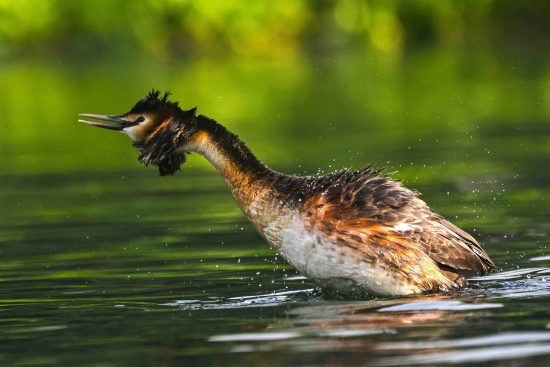
*The great crested grebe is an expert diver, plunging deep underwater with smooth precision to catch fish and escape danger.
Stylish Chicks – Baby grebes are born with black-and-white striped heads, often compared to tiny zebras.
Family Rides – Young chicks often ride on their parents’ backs, tucked safely under feathers, while the adults swim and fish.
Global Traveler – Though common in Europe, Asia, and Africa, some populations migrate long distances, wintering in coastal estuaries and large reservoirs.
Audible Swimmers – Their powerful wing beats can be heard from a distance, especially during courtship flights over wetlands.
❓ Frequently Asked Questions (FAQs)
Q1. Where can I see the Great Crested Grebe?
The Great Crested Grebe is widespread across Europe, Asia, Africa, and Australia. In India, it is a winter visitor to northern lakes and wetlands. They prefer freshwater lakes, reed beds, and slow-moving rivers rich in aquatic vegetation.
Q2. What is unique about the Great Crested Grebe’s courtship?
Their courtship dance, often called the weed dance, is one of the most spectacular bird rituals in the world. Pairs rise chest-to-chest out of the water while presenting aquatic plants, followed by synchronized swimming and dramatic head-shaking displays.
Q3. Why do Great Crested Grebes eat their own feathers?
Grebes swallow their feathers and feed them to chicks. This unusual behavior forms a stomach filter that traps sharp fish bones and protects their digestive system.
Q4. Are Great Crested Grebes endangered?
Globally, the Great Crested Grebe is listed as Least Concern on the IUCN Red List. However, local populations are threatened by wetland destruction, water pollution, and disturbance from human activities such as boating and fishing.
Q5. What do Great Crested Grebe chicks look like?
Chicks are adorably striped in black and white and are often seen riding on their parents’ backs for protection and warmth — one of the most photogenic behaviors of this species.
Q6. When is the best time to photograph the Great Crested Grebe?
The best season is spring (March–May) during their spectacular courtship displays. Golden hours at sunrise and sunset offer the best light for reflections, while the breeding season (March–July) provides opportunities to capture the famous chick-back rides.
Q7. How can birdwatchers and photographers help conserve the Great Crested Grebe?
By practicing ethical photography (avoiding nests and using long lenses), supporting wetland conservation projects, sharing awareness-driven content online, and contributing sightings to citizen science platforms, photographers and birders can make a direct impact.
📘 Conclusion: Protecting Wetland Poetry
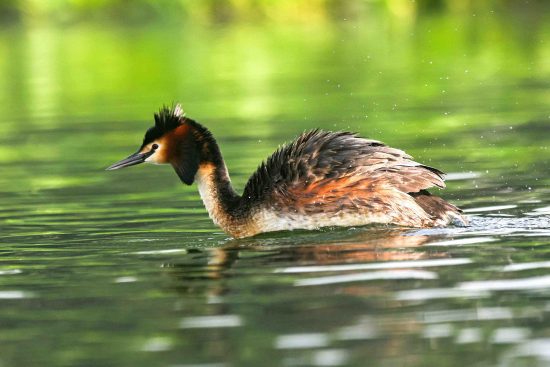
The great crested grebe is more than a symbol of grace; it is a living expression of wetland harmony.
Its elegant courtship dance, distinctive crest, and serene movements reflect the beauty of balance in nature.
These birds thrive only where water is pure and habitats are healthy — making their presence a sign of ecological well-being.
Sadly, wetland destruction and pollution continue to threaten their nesting grounds and food sources.
Every photograph, observation, and conservation effort helps ensure the great crested grebe continues to glide through our lakes for generations.
As photographers and nature lovers, we share the responsibility to protect these fragile ecosystems.
👉 Call to Action: Step out with your camera and heart aligned with purpose. Capture the elegance of the great crested grebe, share its story, and inspire others to conserve wetlands. Every click you take can spark awareness, every post can protect a life. Together, we can turn admiration into conservation.
Recent Comments